An evolving wildlife garden built around water, habitat and natural materials
In spring 2024, we began transforming this established garden in Moortown, North Leeds.
Our approach was to retain what already had value, introduce the structure the garden needed and create a landscape that could become richer and more natural as it matured.
The existing garden already had one enormous advantage, mature trees and established boundary vegetation. Rather than clearing the site and starting again, we designed the new landscape around that maturity.
-
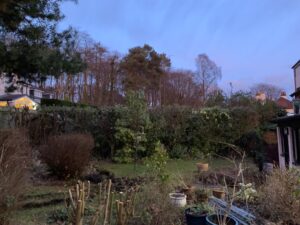
- The existing garden before work began in spring 2024.
-
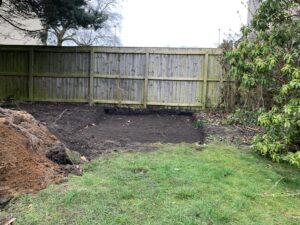
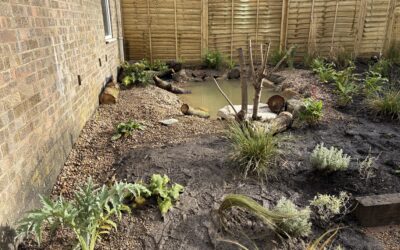
- The first stages of the build, with areas of the existing lawn and planting cleared ready for the new landscape.
Ongoing development
Since the initial build, we have continued working with the owners as the garden has developed. The original still water wildlife pond has been converted into an Aquascape ecosystem pond with a naturalistic stream, planting has continued to evolve and further improvements have included green roofs and rainwater harvesting.
Two years after the original build, the garden is becoming less about the individual things we constructed and more about the landscape they have created together.
The build introduced substantial changes in level, oak retaining structures, gravel paths, a circular clay paver seating area, extensive naturalistic planting, deadwood habitat and a large wildlife pond.
It was also never intended to be a garden that was finished on the day we left.
Working with the existing landscape
One of the biggest assets of the original garden was something that can’t simply be bought and installed, maturity.
Large trees and established vegetation gave the site enclosure, shade and character. They also provided existing habitat that would have taken many years to recreate.
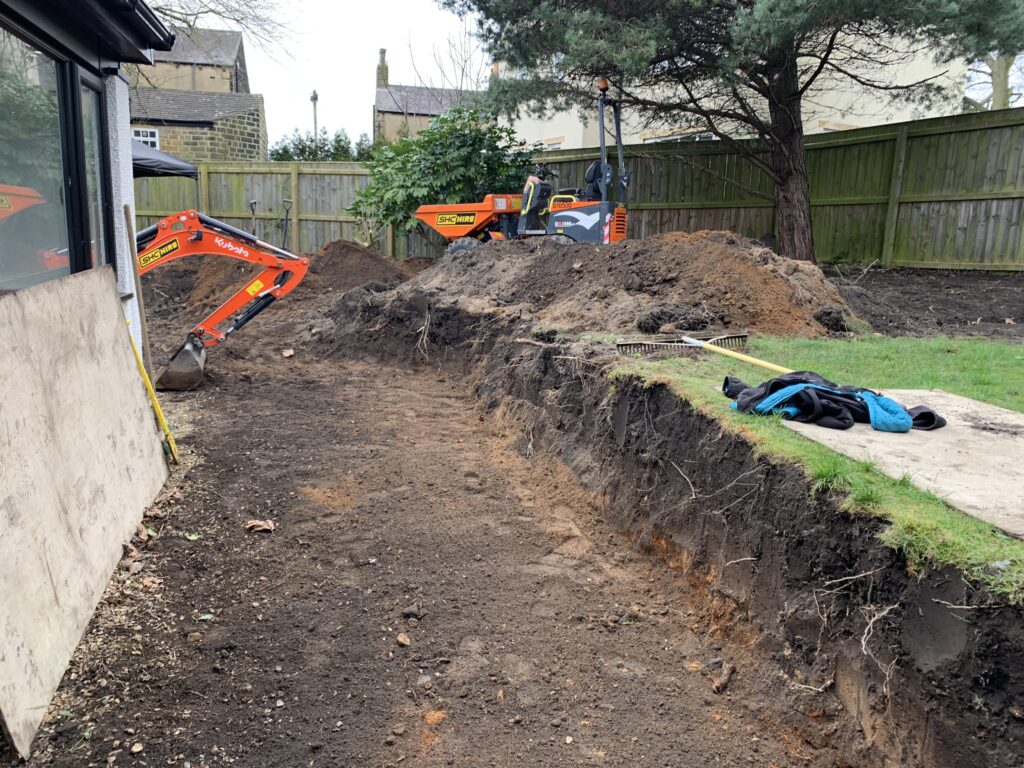
Major earthworks underway during the transformation of the garden in spring 2024.
The challenge was to introduce a completely new garden without losing that sense of establishment.
There were also significant changes in level to resolve. During construction, substantial excavation and groundworks reshaped the lower garden and large oak retaining structures were installed to retain the higher ground.
A central flight of steps, combining clay brick risers with natural stone treads, connects the different levels.
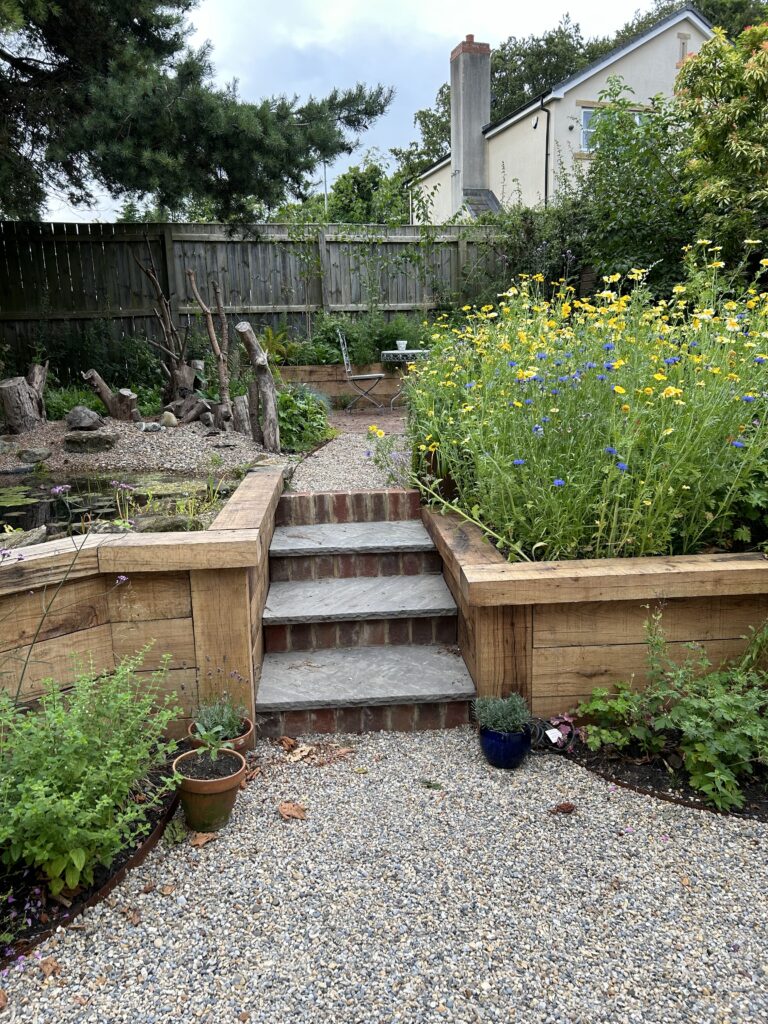
The completed changes in level, with oak retaining beds, stone and brick steps, gravel paths, dense flowering planting and the pond beyond.
These are substantial pieces of landscaping, but they were never intended to dominate the finished garden. The structure provides the framework, while planting, water and natural materials increasingly soften it.
Looking at the garden two years later, much of the construction that was so obvious when we finished the original build is already disappearing into the landscape.
A simple palette of natural materials
We deliberately kept the material palette relatively restrained.
Oak, clay paving, natural stone, gravel, weathering steel and deadwood repeat throughout the garden. This creates continuity between the more constructed areas and the increasingly informal planting.
The paving was supplied by London Stone, including the clay pavers used to create the small circular seating terrace and the natural stone incorporated elsewhere in the garden.
Gravel paths provide the main circulation through the wildlife areas. Rather than using large expanses of impermeable paving, these create a softer surface that sits naturally alongside planting, stone and timber.
We used gravel stabilisation grid and landscape edging from CORE Landscape Products to provide structure beneath and around these areas without making the paths visually dominant.
The paths themselves curve through the garden, responding to the existing trees, pond, changes in level and planting rather than imposing a rigid geometry onto the site.
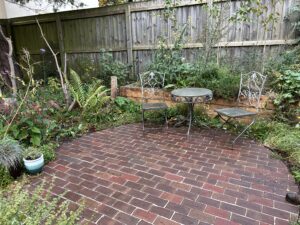
A clay paver terrace surrounded by planting
At the upper end of the garden, we constructed a small circular seating terrace using clay pavers supplied by London Stone.
Immediately after construction it was a very obvious piece of hard landscaping. The paving was crisp and clearly defined, with relatively young planting surrounding it.
Two growing seasons later, the relationship has changed.
Perennials now grow towards the edges of the paving and taller vegetation creates enclosure around the seating area. What initially looked like a newly constructed patio increasingly feels like a clearing within the planting.
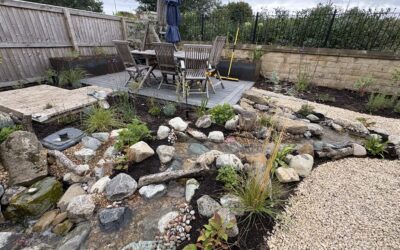
Two years after construction, the pond, stream and naturalistic planting have become established throughout this Moortown garden.
This is something we aim for in many of our naturalistic gardens.
Hard landscaping still matters. Gardens need comfortable places to walk, sit and live, but those surfaces don’t necessarily need to dominate the landscape.
Here, the terrace provides the function and the vegetation increasingly provides the experience.
Creating the original wildlife pond
Water was central to the garden from the beginning.
During the original build in spring 2024, we constructed a large still water wildlife pond amongst the existing mature trees.
Rather than creating a uniform pond edge, we used stone, gravel, timber and aquatic planting to create different conditions around the margins.
Shallower areas of water and gravel sit alongside larger stones, planting and deeper open water. Pieces of timber extend into and around the pond, helping to blur the distinction between the aquatic and terrestrial parts of the garden.
The intention was for the pond to feel embedded within the wider landscape rather than appearing as a separate feature that had simply been inserted into it.
Once the pond had been functioning for a while, however, one of the garden’s most important existing features presented us with a challenge.
From a still water pond to an Aquascape ecosystem pond
A large mature pine stands over the garden.
Retaining it was important because it contributes enormously to the character of the site and forms part of the mature habitat around which the new garden was designed.
It also produces a considerable amount of organic matter.
Pine needles and other material naturally found their way into the still water pond. As we watched the pond develop, it became apparent that the volume of organic material entering the water meant we needed a more effective way of managing the system.
Rather than removing the tree or continually fighting against the conditions it created, we adapted the pond.
We retrofitted the original wildlife pond as an Aquascape ecosystem pond, introducing circulation and filtration and constructing the naturalistic stream that can be seen in the garden today.
Water is circulated through the ecosystem and returned to the pond through the stream, passing amongst stone and gravel before flowing back into the main body of water.
The stream therefore wasn’t added simply because moving water looks attractive. It was a practical response to what we learned from the pond once it had been functioning beneath the mature pine.
The change also created an additional habitat.
Alongside the deeper and quieter water of the main pond, shallow oxygenated water now moves amongst rocks and gravel within the stream. Vegetation and moss have begun colonising its edges and, in places, the water disappears beneath plants before emerging again between the stones.
What began as a practical solution has become one of the most natural looking parts of the garden.
Becoming Certified Aquascape Contractors
This pond also has particular significance for Rewild Landscapes.
The build was one of the projects that contributed towards us becoming Certified Aquascape Contractors.
Aquascape ecosystem ponds use a combination of biological and mechanical filtration, circulation, rocks, gravel, aquatic plants and the wider pond ecosystem to maintain a balanced body of water.
For us, the system fits particularly well with the kind of landscapes we want to create. It allows us to build substantial water features that can be integrated into planting and habitat rather than feeling separate from the rest of the garden.
The experience of returning to this particular pond, understanding how it was responding to its surroundings and subsequently converting it into an ecosystem pond has also influenced the way we approach water in later projects.
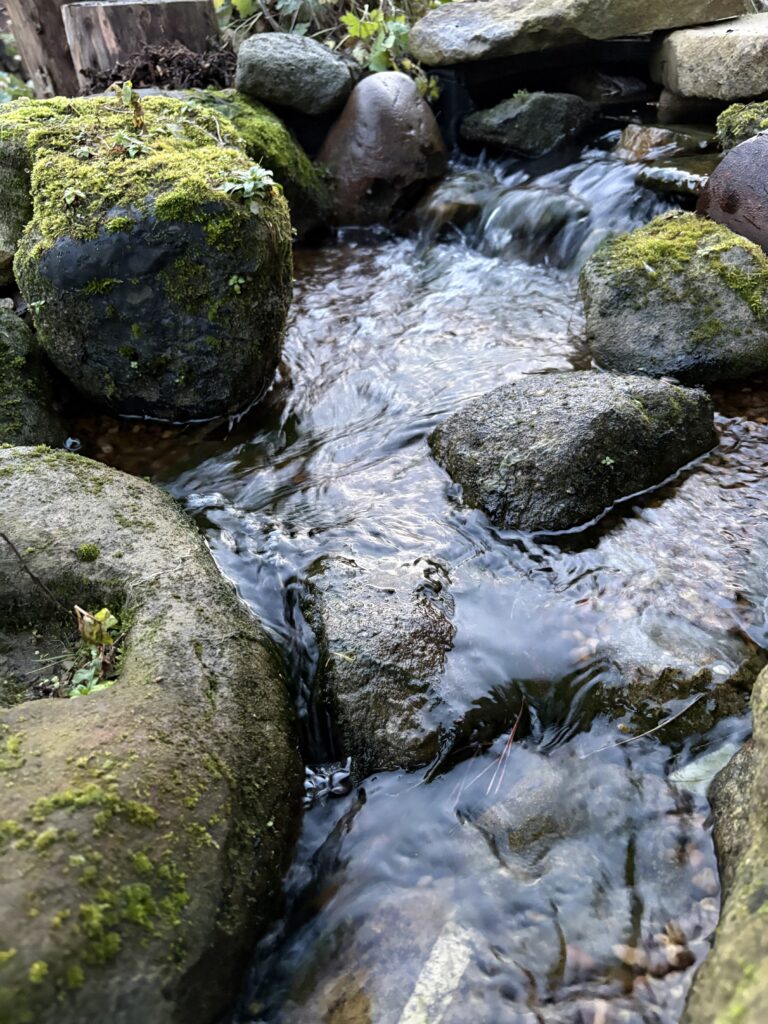
The stream was retrofitted after the original still-water pond struggled with the volume of organic matter falling from the mature pine.
Making deadwood part of the garden
Deadwood is often treated as something that needs to be removed from a garden.
Here, we did almost the opposite.
Logs, trunks, stumps and upright sections of timber were incorporated throughout the landscape, particularly around the pond.
Some of these pieces have a strongly sculptural quality, but they aren’t simply garden ornaments.
Dead and decaying timber provides habitat for fungi, microorganisms and a huge range of invertebrates. Those organisms subsequently form part of the wider food web within the garden.
Rather than relegating that habitat to an unseen corner, we wanted to make it part of the landscape.
Groups of upright timber create standing deadwood habitat, while fallen pieces lie amongst stone, gravel and vegetation around the pond.
As the garden has matured, plants have grown around and through them and the timber has begun to weather and decay naturally.
Decay isn’t something we’re trying to disguise. It’s part of how the garden works.
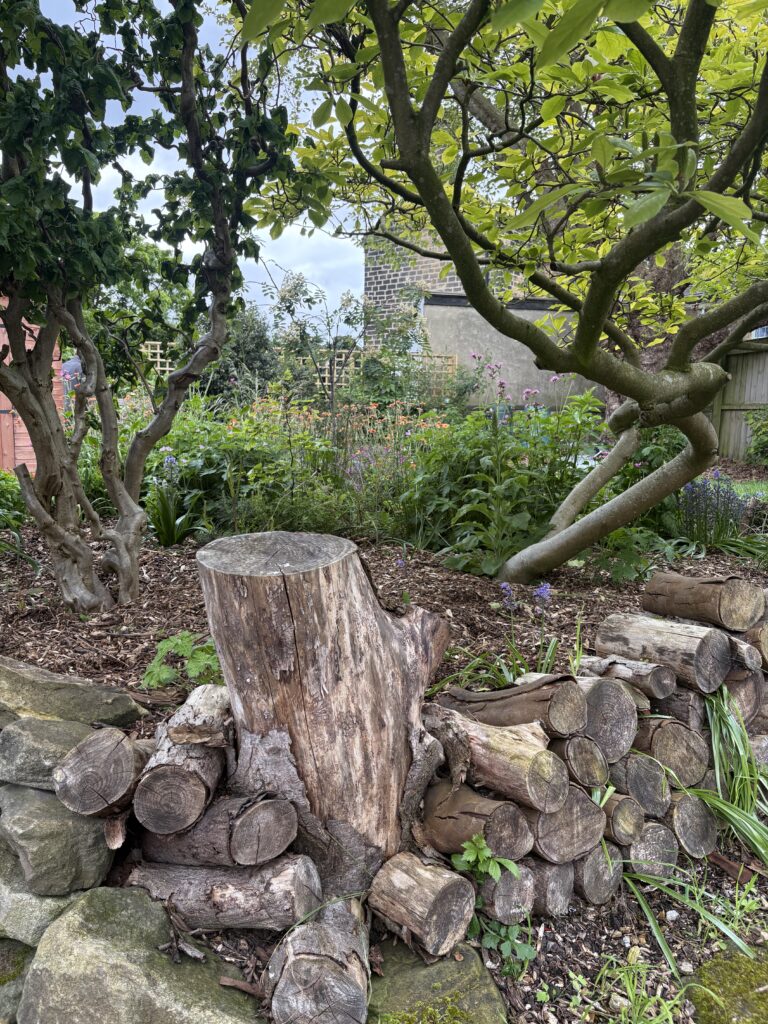
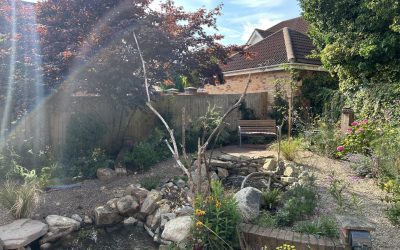
Logs, stumps and stone were incorporated into the garden to create structural habitat for insects, fungi and other wildlife.
Planting for abundance
The planting for the project was supplied by Johnson’s Nurseries and was designed to become increasingly abundant as the garden established.
Rather than creating isolated groups of ornamental plants surrounded by large areas of bare soil, we wanted vegetation to knit together.
Wildflowers, herbaceous perennials, grasses and existing vegetation intermingle throughout the garden, with different areas allowed varying degrees of informality.
During summer, areas become filled with flowering plants, while geraniums and other perennials spread beneath taller vegetation. Larger architectural plants provide occasional structure within the looser planting.
Around the pond and stream, aquatic and marginal plants increasingly blur the transition between the constructed water feature and the surrounding garden.
This density has an aesthetic purpose and an ecological one.
Flowers provide forage for pollinating insects, dense vegetation provides shelter, the pond provides permanent water and deadwood supports another community of organisms.
The aim isn’t simply to add a collection of individual wildlife features.
It is to allow those habitats to connect.
Designing a garden that becomes less designed
Perhaps the best way to understand the project is to compare photographs taken during construction in 2024 with the same views today.
Immediately after the build, the landscaping is obvious.
The oak retaining walls are prominent. Gravel paths are clean and clearly defined. The circular terrace has a crisp edge. Individual plants sit within newly prepared ground. Stone and timber around the pond are exposed.
All of that structure was necessary to create the garden, but it wasn’t intended to remain the main feature.
As the vegetation has established, the visual hierarchy has changed.
Today, you notice the planting, water, mature trees and movement through the vegetation first.
The retaining walls are still there and so are the paths, steps and terrace, but increasingly they sit underneath the experience of the garden rather than defining it.
For us, that’s one of the most satisfying stages in the development of a naturalistic landscape.
Sometimes successful landscaping should eventually become difficult to see.
A garden that continues to evolve
The original spring 2024 build wasn’t the end of our involvement with the garden.
We have continued working with the owners, watching how different areas develop and making further interventions where they can improve the ecology or the way the garden functions.
The conversion of the original pond into an ecosystem pond is perhaps the clearest example.
We didn’t predict every aspect of how the still water pond would respond to its position beneath the mature pine. Once we understood the amount of organic material entering the water, we changed the system.
That’s an important part of working with living landscapes.
Trees grow, plants spread, shade changes, water moves, organic material accumulates and wildlife arrives. Some plants thrive and others don’t.
A garden isn’t a static object and we don’t think it should be managed as one.
That same process is continuing elsewhere in this Moortown garden.
Additional planting is increasing the diversity and structure of the vegetation and green roofs are adding planted habitat to surfaces that would otherwise contribute relatively little to the garden.
The next stage is rainwater harvesting. A Wild Water system will capture rainfall from the property and store it for reuse in the garden, reducing reliance on mains water during prolonged dry periods.
Rather than treating rainfall simply as something to drain away, our aim is to keep more water within the landscape and make it available when the garden actually needs it.
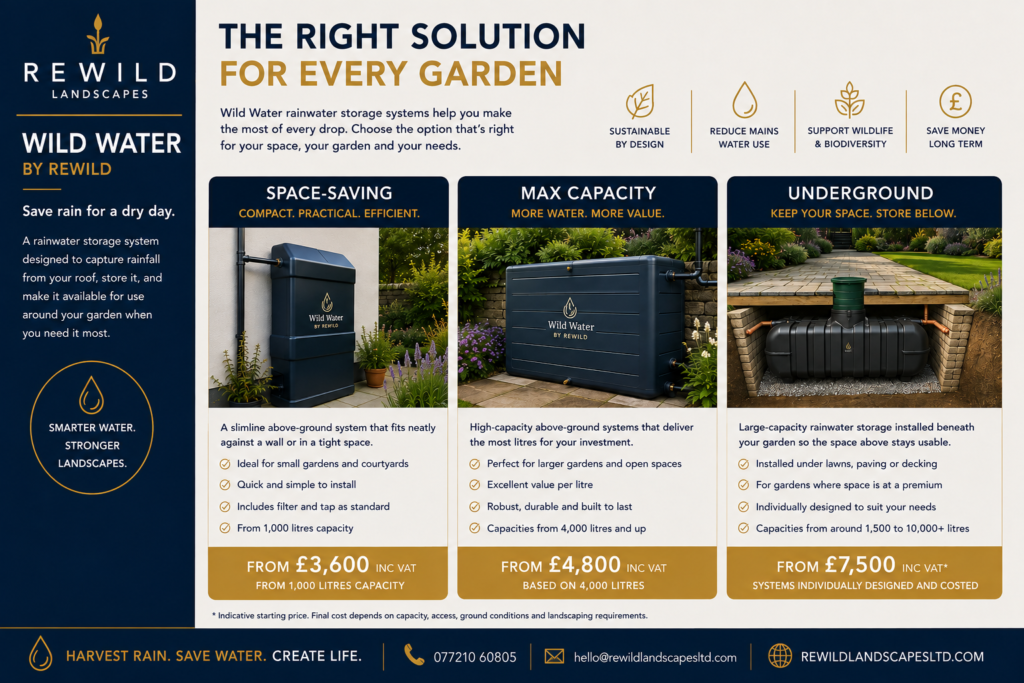
Wild Water by Rewild Landscapes offers above-ground and underground rainwater storage systems designed around individual gardens.
These interventions increasingly connect.
Rain falling on a roof can be captured and stored. Stored rainwater can support planting during prolonged dry periods. Green roofs can provide habitat and slow runoff. Dense vegetation provides food and shelter. Deadwood supports fungi and invertebrates. The pond provides permanent aquatic habitat and the stream adds moving, oxygenated water.
Together, these elements allow a domestic garden to function as a much more complex landscape.
Two years on
Two years after the original build, the garden has entered a very different stage of its life.
The pond edges have softened, water lilies occupy the open water and moss and vegetation are colonising the stream.
Plants have spread between the paths and seating areas. Deadwood is weathering and decaying. The clay paver terrace is becoming enclosed by vegetation and views that appeared relatively open immediately after construction are increasingly filled with planting.
The garden will continue changing and we will continue working with it.
That’s not something we’re trying to prevent.
It’s the point.
Wildlife landscaping in Moortown, Leeds
Rewild Landscapes designs and builds ponds, meadows and natural landscapes across Moortown and North Leeds.
We combine practical landscaping with water, naturalistic planting and habitat creation to produce gardens that work for people and provide considerably more space for wildlife.
This Moortown garden is a good example of that approach. It isn’t simply a wildlife pond, planting scheme or landscaped garden. It is an evolving landscape where the different elements increasingly work together.
If you’re considering a wildlife garden, naturalistic garden, ecosystem pond or wider garden transformation in Moortown, we’d be happy to discuss what could be possible in your garden.
Project suppliers and partners
Paving and natural stone: London Stone
Plant supply: Johnson’s Nurseries
Pond system: Aquascape
Gravel grid and landscape edging: CORE Landscape Products
Landscape construction and ongoing development: Rewild Landscapes Ltd, Certified Aquascape Contractor