Linking Urban Green Spaces Through Zero-Irrigation Design
In the first two parts of this series I looked at plant selection and the role of substrates when designing for zero irrigation. Those ideas sit at the scale of individual planters. The bigger opportunity for sustainable urban green space design is at city or town planning level. A single pocket of planting is useful and has its merits, however a network of green spaces is far more effective.
Most urban planting exists in isolation: a planter outside an office, a strip of soil beside a car park, a verge on a main road or a small courtyard bed. Each one tends to be treated as a standalone piece. When they are connected, they behave very differently.
Zero-irrigation planting makes that easier. If a space does not rely on irrigation lines or regular watering visits, it becomes realistic to place planting in the more difficult corners of a city. These pockets then act as connectors between the larger green assets.
There are a few ways this shows up.
Linear routes
- street trees with space for drought-tolerant underplanting, using permeable paving around the base to allow gas exchange and water to move into the soil, and planting that cools and protects the soil rather than hard surfacing tight to the trunk
- verge planting that runs from one street to the next
- planting along cycle routes and footpaths
- softer edges that allow wildlife to move between bigger areas
Stepping-stone spaces
- courtyard planters
- pocket parks
- small planted corners that would usually be paved
- roof terraces and balconies
Transitions and edges
- planted thresholds between buildings and pavements
- mixed substrates in front of entrances rather than bare gravel
- sheltered pockets around benches or bike stands
- planting on the sunny side of walls or railings
It is often the in-between spaces that do the most work. You don’t need a large park to increase ecological value. You need frequency, proximity and continuity.
A good example of how this can work in practice already exists in the form of old canal towpaths. Many of these have effectively rewilded themselves over time with no irrigation, constant exposure and very little soil. Despite the narrow width they act as long, continuous nature corridors that cut through towns and cities. The mix of grasses, drought-tolerant wildflowers, cracks in the masonry and sheltered banks supports far more wildlife than their size would suggest. They show what is possible when a linear route is allowed to function as habitat rather than hard edges and tight surfacing, and they offer a useful reference point for how smaller urban planting pockets can join up larger green spaces.
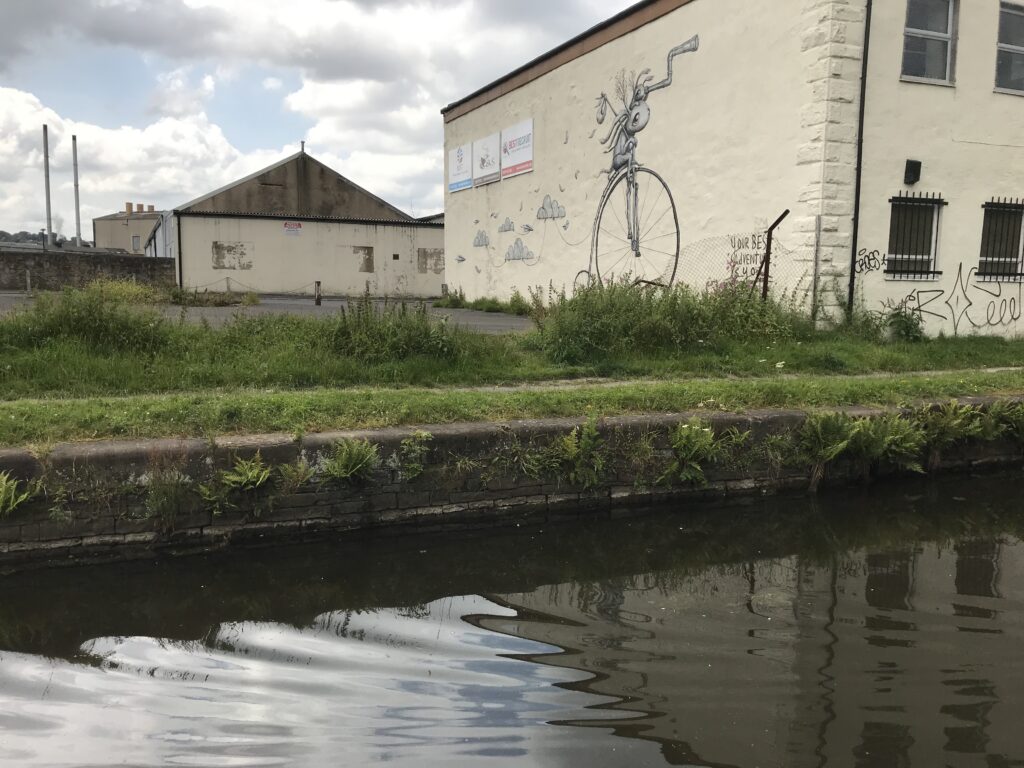
Canals provide valuable green and blue corridors through urban areas, connecting fragmented habitats and supporting wildlife.
The Leeds Liverpool canal historically connected some of the most industrialised areas of the north of the UK and now acts as an incredible linear connection between urban spaces.
Zero-irrigation planting also pairs well with the larger green infrastructure already present in many towns and cities. Bioswales, rain gardens, street trees, urban forests and community orchards sit at a wider scale. What is ofter missed are the smaller elements that join them together. When these smaller pockets use drought-tolerant planting and don’t rely on irrigation, they become reliable connectors that strengthen the whole system.
Research backs this up. Forest Research highlights that green networks, corridors and stepping-stone habitats help counteract habitat fragmentation in urban areas. Other studies show that the position and frequency of small green spaces can influence biodiversity as much as the size of the main parks. This is a strong case for treating these smaller pockets as part of a wider network rather than decorative extras. Zero-irrigation planting works well here because it is robust, low-input and better able to cope with heat and exposure.
There is a resilience angle too. Larger SuDS features deal with stormwater during heavy rain. Street trees improve microclimates and help reduce heat. Zero-irrigation planting supports both by filling the gaps between them with permeable, drought-resilient plant communities. Together they create a city landscape that is cheaper to maintain, better for wildlife and more able to cope with extremes of weather.
There are UK native species that cope surprisingly well with these conditions and still bring a lot of visual interest. Yarrow, Field Scabious and Viper’s Bugloss all handle heat, drought and reflected light. Grasses such as Sheep’s Fescue and Red Fescue cope with poor soils and help stabilise the ground around verges and tree pits. Coastal natives like Bird’s-foot Trefoil and Thrift tolerate dry soils, salt splash and polluted runoff. These species work well without irrigation and offer strong habitat value in places where planting usually struggles.
Vipers Bugloss is a magnet for pollinators and a prolific self seeder
Many of these plants support a good range of invertebrates despite the harsh conditions. Yarrow attracts hoverflies and small tortoiseshell butterflies. Field Scabious is a major nectar plant for marbled whites and several long-tongued bees. Viper’s Bugloss is one of the best forage plants for red mason bees and bumblebees during dry spells. Grasses such as Sheep’s Fescue and Red Fescue support the larvae of meadow browns and gatekeepers. Bird’s-foot Trefoil is a key food plant for common blues, and Thrift provides nectar for solitary bees in exposed sites.
As more towns and cities look for low-input, climate-resilient planting solutions, the combination of these approaches becomes more relevant. The key is to see the city as a joined landscape, not a collection of isolated sites. A planter becomes part of a network, not a standalone feature.
If you have worked on projects that link green spaces in this way, or have examples of planting that connects the larger features within a city, I would be interested to see them. If you are working on projects where these ideas overlap with architecture or urban design, I would be interested to hear how you approach them. Different disciplines see opportunities in different places, and those perspectives are always useful.