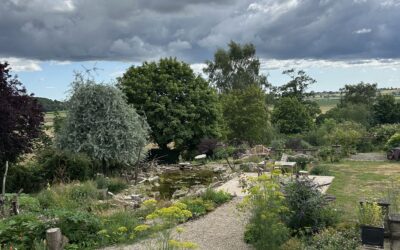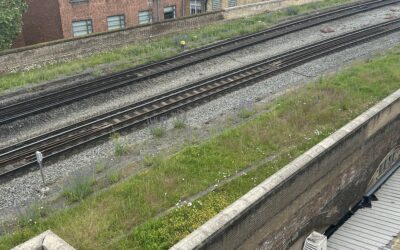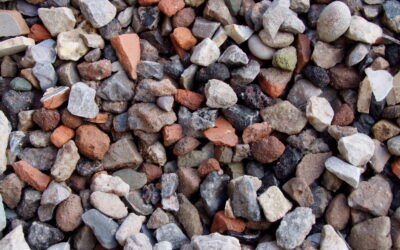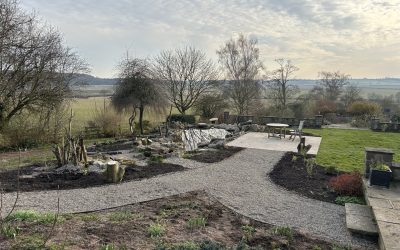
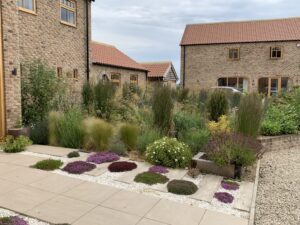
A successful zero irrigation scheme in North Yorkshire. No soil improvement (gravel mulch only). Designed and installed by Rewild Landscapes Ltd. 2022
Zero irrigation planting is not a new idea. Beth Chatto wrote The Dry Garden decades ago and the core message still holds up. Right plant. Right place.
This scheme is from part of a private garden in Fangfoss in North Yorkshire that I designed and built for a couple over a period of 7 months in 2021/ 2022. I took the cover photograph a year after we completed the planting. The courtyard faces southwest and is enclosed by brick walls on three sides. The developer of the site finished the drive with limestone chippings which reflects a huge amount of heat and light back into the planting. In the summer of 2023 the temperature in this space reached forty degrees and in winter it dropped to minus nine. The clients asked me to maximise benefit to wildlife, keep maintenance to a minimum and still have plenty of kerb appeal.
I very quickly discovered that the layout of the buildings meant that the courtyard behaved like a wind tunnel. Along side this, it also sits in the rain shadow of the Yorkshire Wolds which means significantly reduced rainfall compared to the rest of Yorkshire. As a result I had to design the planting so that it was able to cope with a combination of difficult conditions:
Site stresses
-
High heat
-
Strong light reflection from hard surfaces
-
Rapid drying
-
High wind exposure
-
Low rainfall
-
Very low winter temperatures
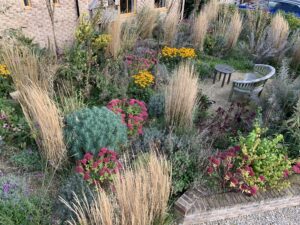
Beyond its initial planting, we have never had to water this bed. We didn’t undertake any soil improvement apart from removing the turf, a thin gravel mulch was added and that was as far as it went. Most of the plants were pot grown with a handful grown from seed.
What I like about this scheme is how well it has held up despite those conditions. It has shown that if you properly match the planting to the site you can still achieve a lush, varied and interesting space with zero irrigation. Even in a courtyard that reaches forty degrees in summer and drops to minus nine in winter the planting can thrive if the palette is chosen carefully.
I feel that one of the real strengths of this space is how the density and variety of the planting supports the soil. The wide range of root structures helps with drainage and slows the movement of water through the ground. I designed the garden so that the soil surface is almost fully covered throughout the year, we achieved this through the use of prodigious self seeders such as verbena and echium vulgare. Any gaps are quickly colonised. Where there are small areas of bare ground because plants have died back or not yet spread the gravel mulch slows surface run off. The result is a courtyard that holds moisture for longer, dries out more evenly and stays resilient without irrigation.

Verdant green spaces can still be zero irrigation, even in tough conditions.
Current Thinking
As I said at the beginning of this article, this information isn’t new there are plenty of references in the current literature.
The RHS advice on soils that swing between wet and dry makes the point that plant choice should reflect changing moisture levels rather than assuming consistency: https://www.rhs.org.uk/plants/for-places/wet-dry-soils
Kew’s Grow Wild programme highlights how many UK native species from exposed coastal landscapes are naturally suited to dry, free draining urban sites: https://growwild.kew.org/blog/coast-garden-drought-tolerant-uk-native-plants
Beth Chatto Gardens also have an excellent example of drought tolerant planting in their car park scheme which has been managed without irrigation specifically to demonstrate what is possible: https://www.bethchatto.co.uk/discover/our-blog/news/drought-tolerant-planting-in-the-carpark.htm
And the UK Rain Garden Guide stresses that planting in features which are sometimes wet and often dry requires species that tolerate both extremes: https://raingardens.info/wp-content/uploads/2012/07/UKRainGarden-Guide.pdf
Beth Chatto showed what was possible in a domestic garden. The next step is to carry these principles into the tougher urban and commercial spaces that need resilient low-input planting the most.